Hybrid vs. EV vs. Gas: Which Makes Sense for Driving in LA?
Your next car should fit your commute, your parking situation, and your budget. Here’s how to compare hybrids, electric cars, and gas cars without getting lost in the hype.
In Los Angeles, “I’m only 15 miles away” is not an arrival time.
Your drive might involve freeway miles, neighborhood errands, and enough stop-and-go traffic to finish an entire podcast. So when someone asks whether a hybrid, an electric car, or a gas car is best, my first question is simple:
Where do you drive—and where do you park when you get home?
My starting recommendation: if you have dependable charging, put an EV on your shortlist. If charging would be a weekly puzzle, compare a conventional hybrid. If you drive relatively little, keep a reasonably priced gas car in the conversation.
Then compare the actual vehicles and costs. The badge on the back doesn’t settle the decision.
A hybrid is worth considering when charging would complicate your life
A conventional hybrid combines a gasoline engine with an electric motor. You don’t plug it in. Its battery receives energy from the engine and regenerative braking, which captures some energy as the vehicle slows down.
U.S. Department of Energy: How hybrids work
For someone living in an apartment without dependable charging, that makes a hybrid a practical place to start.
You still visit a gas station, but you can compare models that use less fuel while keeping a familiar routine. Look at the specific vehicle’s city and highway ratings instead of assuming every hybrid delivers the same advantage.
There’s also a price question. If the hybrid version costs more, how much fuel would you need to save to make up the difference?
Someone driving every day and someone driving twice a week may reach different answers. Both can be right.
An EV deserves a serious look when charging fits into your routine
Before comparing screens, acceleration, or wheel designs, figure out where you would charge.
Home charging can let you replenish the battery while the car is parked overnight. But having a parking space doesn’t automatically mean you have a suitable charging setup. Apartment access, installation permission, electrical capacity, and equipment costs all deserve attention before you buy.
U.S. Department of Energy: Charging at home
Reliable workplace charging could also be part of your plan. Check availability, access hours, prices, and what happens if those spaces are occupied.
Public charging can work, too. Just build your decision around the stations you would actually use. Visit them at your usual travel time and check vehicle compatibility, posted fees, and backup options.
The Department of Energy notes that public charging—especially DC fast charging—normally costs more than charging at home. Your own rates matter more than someone else’s claim that charging is “basically free.”
U.S. Department of Energy: EVs for consumers
A nearby charger is useful. A dependable charging routine is what you’re trying to establish.
A gas car can still make sense
A gasoline car deserves consideration if you drive relatively little, lack convenient charging, or find a vehicle that meets your needs at a substantially lower purchase price.
Imagine two shoppers. One has a long daily commute. The other works from home and mostly drives for groceries and weekend plans.
The second shopper has fewer miles over which to recover a higher purchase price through energy savings. That doesn’t automatically make a gas car the winner, but it makes the upfront price especially relevant.
If you regularly take long trips, compare how each specific vehicle would handle your usual routes. For an EV, include charging stops and alternatives. For every vehicle, think about comfort, cargo space, and the full trip cost.
You’re buying something to live with. Familiarity and convenience belong in the calculation.
What about a plug-in hybrid?
A plug-in hybrid, or PHEV, has both a gasoline engine and a battery you can charge externally. It can cover some driving electrically and use gasoline as needed; electric range and engine operation vary by model and conditions.
U.S. Department of Energy: How plug-in hybrids work
It’s worth comparing if you can charge regularly and want electric driving for everyday trips with gasoline available for longer ones.
Ask yourself whether you would actually plug it in. If the answer is “probably not,” compare its purchase price and gasoline-mode efficiency with a conventional hybrid before choosing it.
Compare the whole ownership cost
Fuel or charging is only part of the bill. Before deciding, gather:
- The actual purchase price, including applicable taxes and fees.
- Insurance quotes for the specific vehicles.
- Energy estimates based on your mileage and local rates.
- Any home charging installation costs.
- Maintenance needs and warranty coverage.
- Your expected ownership period and likely resale value.
EVs generally need less routine maintenance than comparable conventional vehicles because they have fewer moving parts and no engine oil changes. That still leaves tires and other scheduled service, and lower maintenance doesn’t guarantee the lowest overall cost.
U.S. Department of Energy: EV maintenance
Frank’s take
Start with an ordinary week.
Where is the car parked? How far do you drive? How often do you travel farther? What would charging actually look like on a busy Tuesday?
For someone with dependable charging, an EV could fit beautifully. For someone who wants better fuel economy without arranging charging, a hybrid deserves a close look. For someone driving fewer miles, a well-priced gas car could make more financial sense.
Choose the car that works for the life you already have.
What does your driving week look like—and could you reliably charge at home or work?
About this guide
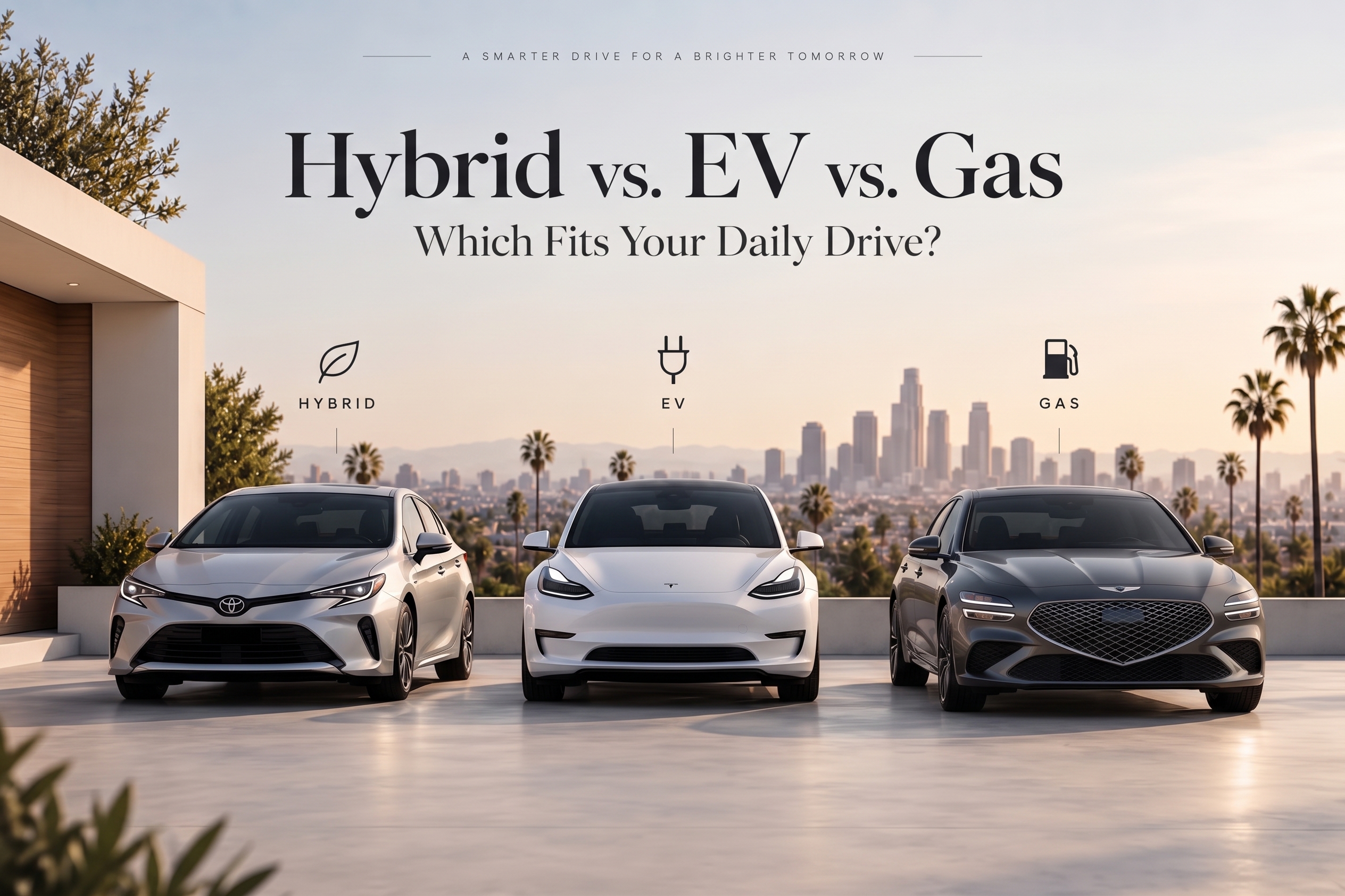
This article provides general comparisons, not a vehicle-specific savings guarantee. Costs, efficiency, range, charging access, and warranty terms vary by vehicle and circumstances. The cover is an illustrative comparison, not a specification or endorsement of the vehicles shown.
Frank The Tank is an independent automotive entertainment and media brand, not an official manufacturer or dealership account.